ptr_app(
  "ggplot(iris, aes(x = ppVar(shared = 'col'), y = ppVar - ppVar(shared = 'col'),
                    color = Species)) + geom_point()"
)A placeholder annotated keyword(shared = "<key>") is driven by one widget in lockstep wherever that key appears — across aes(), pipeline stages, and (in the multi-plot case) across formulas. Where that widget surfaces is decided per key by how many formulas reference it — the partition rule:
A shared key referenced in exactly one formula → that formula’s inline shared section, rendered inside its own control panel. A shared key referenced in two or more formulas → the one standalone shared panel.
Example: f1 = sharedA + sharedA + sharedB, f2 = sharedC + sharedC + sharedB ⟹ f1’s inline section holds sharedA, f2’s holds sharedC, the standalone panel holds sharedB.
The practical consequence is a hard split by instance count.
11.1 One instance: no coordinator, ever
With a single ggpaintr instance every shared key is formula-local by definition, so it auto-renders in that instance’s inline shared section. The single-instance realization is plain L1 ptr_app() — write the annotation and you are done:
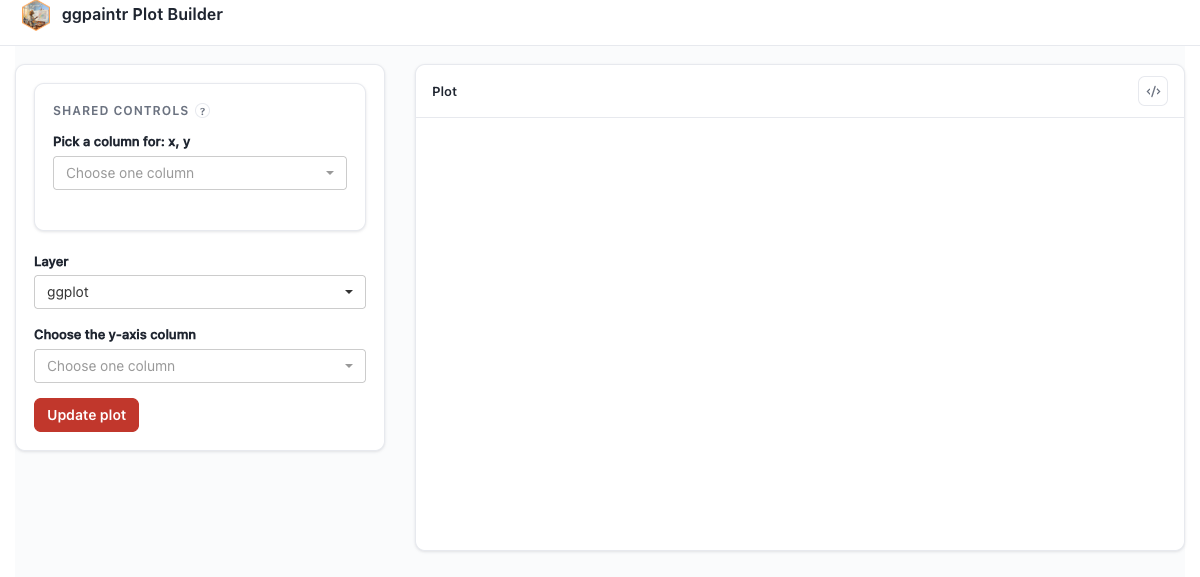
Bare ptr_server() on a shared = "..." formula behaves the same way: it self-binds every declared key under its own namespace and renders the widgets inline, exactly like ptr_app() does.
11.2 Multiple instances: the shared trio
When you embed two or more ggpaintr blocks (Chapter 10) and want one widget to drive several of them, build the coordinator once and feed it to the three consumers. The contract:
ptr_shared(formulas, ...)→obj. Pass the same list of formula strings you will hand to the modules. Widgets for shared keys are auto-built from each key’s placeholder kind — appVar(shared = "...")gets a column picker, appNuma numeric input, and a registered custom placeholder its ownbuild_ui.objcarries the computed partition (obj$panel_keys, plus the per-formula local keys) and is pure and non-reactive, so the UI and server can never disagree about which key lives where.ptr_shared_panel(obj, css = NULL)— the one standalone panel, holding exactlyobj’s cross-formula keys. Self-contained; place it once, wherever you want on the page.ptr_shared_server(obj)— call once at the top level of your server (never insidemoduleServer()). Returns the shared-state bundle.ptr_server(formula, id, shared_state = <bundle>)— pass the bundle to every per-plot module. Each module renders its own formula-local keys inline and reads the panel keys from the bundle.
plots <- list(
  "ggplot(iris, aes(x = ppVar(shared = 'metric'), y = Sepal.Length, fill = Species)) + geom_boxplot()",
  "ggplot(iris, aes(x = ppVar(shared = 'metric'), y = Sepal.Width,  fill = Species)) + geom_violin()"
)

obj <- ptr_shared(formulas = plots)

ui <- shiny::fluidPage(
  shiny::titlePanel("My host app"),
  ptr_shared_panel(obj),
  shiny::fluidRow(
    shiny::column(6, ptr_ui(plots[[1]], "plot_1", shared = obj)),
    shiny::column(6, ptr_ui(plots[[2]], "plot_2", shared = obj))
  )
)
server <- function(input, output, session) {
  sh <- ptr_shared_server(obj)
  ptr_server(plots[[1]], "plot_1", shared_state = sh)
  ptr_server(plots[[2]], "plot_2", shared_state = sh)
}

shiny::shinyApp(ui, server)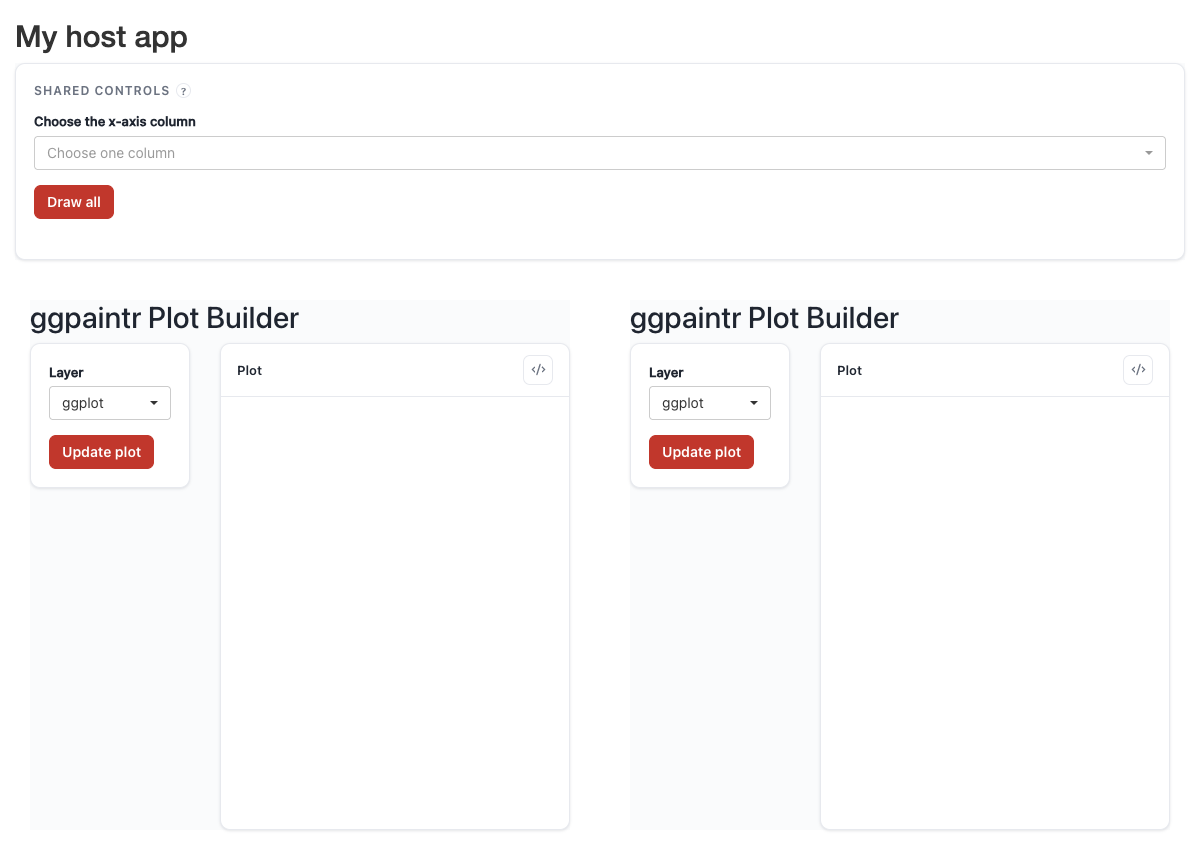
metric is referenced by both formulas, so its picker lives in the standalone shared panel on top; picking a column and clicking Draw all redraws both plots in lockstep.ptr_shared_panel() emits a Draw all button (top-level input id ptr_shared_draw_all) whenever the coordinator spans two or more formulas and the gate_draw setting is on (the default; ptr_options(gate_draw = FALSE) drops the button and each panel re-renders live instead); the per-module Update plot buttons still work independently. Building ptr_shared() from a formulas list that declares no shared = "..." annotation is an error — drop the coordinator and use the plain module path if nothing is shared.
11.3 The partition in action
Mix a cross-formula key with formula-local ones and the rule sorts every widget into the right place:
plots <- list(
  "ggplot(iris, aes(x = ppVar(shared = 'ax1'), y = ppVar - ppVar(shared = 'ax1'),
                    color = Species)) + geom_point(size = ppNum(shared = 'sz'))",
  "ggplot(iris, aes(x = ppVar(shared = 'ax2'), y = Sepal.Width,
                    color = Species)) + geom_point(size = ppNum(shared = 'sz'))"
)

obj <- ptr_shared(formulas = plots)
# sz → both formulas → standalone panel.  ax1 → only plot_1's inline section.
# ax2 → only plot_2's inline section.

ui <- shiny::fluidPage(
  ptr_shared_panel(obj),             # holds sz only
  shiny::fluidRow(
    shiny::column(6, ptr_ui(plots[[1]], "plot_1", shared = obj)),  # ax1 inline
    shiny::column(6, ptr_ui(plots[[2]], "plot_2", shared = obj))   # ax2 inline
  )
)
server <- function(input, output, session) {
  sh <- ptr_shared_server(obj)
  ptr_server(plots[[1]], "plot_1", shared_state = sh)
  ptr_server(plots[[2]], "plot_2", shared_state = sh)
}

shiny::shinyApp(ui, server)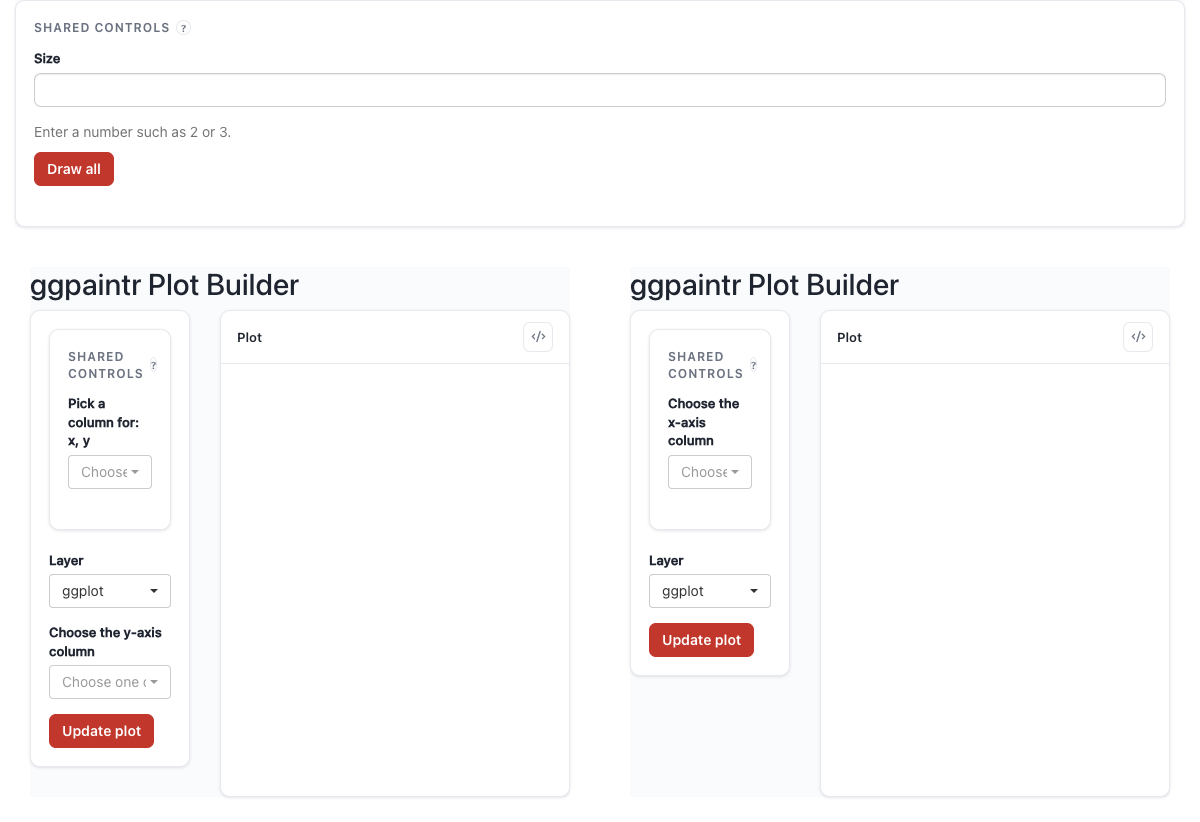
sz; each plot’s inline shared section owns its formula-local axis key (ax1 left, ax2 right).11.4 How input ids are built — and how to avoid colliding with them
The framework names every widget it emits from the formula’s syntax, so the same formula always produces the same ids. When you mix ggpaintr UI with your own widgets in the same Shiny namespace, the cleanest fix is to wrap the embed in ptr_ui() / ptr_server() with a unique id — everything ggpaintr emits then lives under <id>-… and your top-level inputs cannot collide. If you can’t namespace, the surface to avoid:
Layer names. Each top-level call in the formula contributes a layer name equal to the function being called (ggplot, geom_point, facet_wrap, …). Repeats get -2, -3, … suffixes: geom_point() + geom_point() yields geom_point, geom_point-2.
Per-placeholder input ids follow <layer>_<path>_<keyword>_NA, where <path> is the underscore-joined positional index path into the call. aes(x = ppVar, y = ppVar) inside the ggplot() layer yields ggplot_1_1_ppVar_NA and ggplot_1_2_ppVar_NA. A shared annotation never gets a layer-derived id: ppVar(shared = "x_col") is bound at the canonical shared_x_col. Every shared key owns shared_<key> (and, when the key sits on a piped stage, shared_<key>_stage_enabled), so treat those as part of the collision surface too.
Layer-derived ids:
| Pattern | What it is |
|---|---|
<layer>_checkbox |
“include this layer” toggle (no checkbox on ggplot) |
<layer>_<path>_stage_enabled |
per-stage toggle on piped data-arg pipelines |
<placeholder-id>_ui |
renderUI container for any placeholder (value, source, or consumer) |
<layer>_subtab, ptr_layer_content_<layer> |
internal layer-nav and panel-container ids |
Top-level package-owned ids. The framework writes to a fixed set of ptr_-prefixed top-level ids that are not user-configurable: ptr_plot, ptr_error, ptr_code, ptr_code_mode, ptr_update_plot, the panel ids ptr_shared_draw_all / ptr_shared_errors, and the layer-nav inputs ptr_layer_select / ptr_layer_tabset. Treat the whole ptr_ prefix as reserved. When ptr_shared(id = "<id>") is supplied, every coordinator-owned id is carried under an <id>- prefix, so two coordinators can coexist in one session.
Rule of thumb: in a host app’s top-level namespace, don’t author Shiny inputs or outputs whose ids start with
ptr_orshared_, or match<layer-name-from-your-formula>_…. If that feels brittle, wrap the embed with a uniqueidand the collision surface disappears entirely.